How Long Does Meth Stays In Your System . If you’re a frequent meth user, urine tests will likely be able to detect meth in your body for longer than that. The effects of methamphetamine can last for many hours and it may take up to 4 days for the drug to completely leave the body. How Long Does Meth Stay in the System? from www.northpointwashington.com Metabolites may show up in drug tests for days after use. The rate of excretion will vary depending on the method of administration. It usually ends in five minutes, but it can last up to 30 minutes.
System Missing Spss Syntax. The select command with the sysmis() function can drop all missing cases from the current spss data set. In the second method, if any of the variables is missing, it will still calculate the mean.
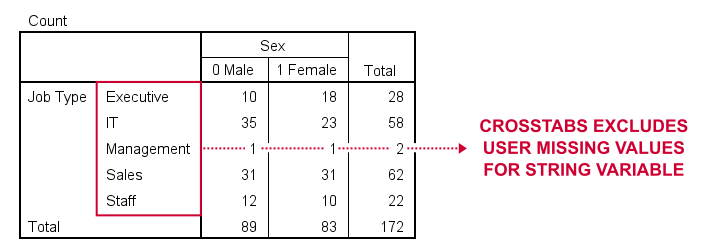
SPSS Missing Values for String Variables Tutorial from www.spss-tutorials.com
Click ok or, you could do all of that in just a few lines of very logical syntax code: Then use the command transform compute variable, in the. For example, suppose you have two variables (v1 and v2), and you wish to recode all cases of v2 to be equal to the system missing value where v1 is also system missing.
For Example, Suppose You Have Two Variables (V1 And V2), And You Wish To Recode All Cases Of V2 To Be Equal To The System Missing Value Where V1 Is Also System Missing.
You cannot define user missing values for long string variables (greater than 8 characters), however. Recode educ (12=2) (16=4) (missing=sysmis) (lowest thru 11=1) (13 thru 15=3) (17 thru highest=5) into educ_cat. Click ok or, you could do all of that in just a few lines of very logical syntax code:
A More Common Scenario Would Be To Use This Variable In A Conditional Statement.
Compute v3 = sum (v1, v2). Because spss works primarily through a gui, it is easiest to present it that way. Missing values are a topic that deserves special attention.
For Example, The Syntax Below Uses If To Replace All System Missing Values By 99.
System missing values occur when no value can obtained for a variable during data transformations. Spss missing values syntax examples (the test data used by the syntax. We'll then label it, specify it as user missing and run a quick check with frequencies.
The Syntax Of The Sum Function Is Just Like The Mean Function, But.
Rather than using the recode command, use an if statement like this: I know of 3 different types of commands and knowing which one to use when is not clear. You can set short string (set to an 8 character width or less) values into user missing values in the variable view, or recode the string variable into a numeric variable and set the specified values to system missing for the new variable.
Now, If Marit Is (System Or User) Missing, Spss Doesn't Know If The Condition Is True And Hence Returns A System Missing Value On Our New Variable.
Spss returns 0 and 1 to represent false and true and hence creates a nice dummy variable. The not condition can be expressed in two ways; Multiple imputation using spss david c.


Comments
Post a Comment